

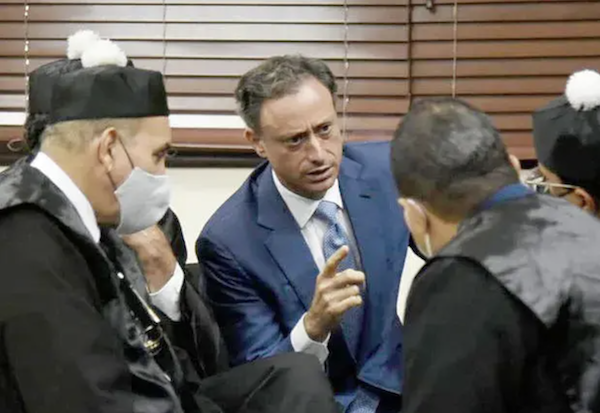
The corruption case against former Attorney General Jean Alain Rodriguez has been postponed for the 22nd time in five years, as of 14 April 2026. The ongoing delays have sparked significant concern among civil society leaders and judicial observers regarding the potential expiration of the legal action.
Jean Alain Rodríguez, who served as the nation’s chief prosecutor from 2016 to 2020, is the primary defendant in the case originally named the Medusa file by the Attorney General Office, then under the hold of Miriam German Brito at the start of the Abinader administration.
The prosecution alleges a massive corruption network involving overvaluation of public works, bribery and diversion of government funds.
The Second Collegiate Court of the National District continues to navigate a sea of procedural motions that have prevented the start of the substantive trial. While the defense team maintains that the delays are a natural consequence of a “weak” and “politically motivated” indictment, the Specialized Prosecutor’s Office for the Prosecution of Administrative Corruption (Pepca) argues that these are tactical maneuvers to exhaust the clock.
Pepca’s Deputy Prosecutor Wilson Camacho has characterized the defense’s actions as “lost time,” accusing the legal team of repeating the same previously rejected motions because they “fear the evidence.”
Concerns from Participacion Ciudadana
Francisco (Pancho) Alvarez, the legal expert and general coordinator for Participación Ciudadana (the local chapter of Transparency International), has voiced sharp criticism regarding the pace of the proceedings. Alvarez warns that the defense strategy is clearly aimed at reaching the four-year limit established by Article 150 of the Criminal Procedure Code. Under Dominican law, if a final sentence is not reached within four years of the start of coercive measures, the criminal action could be declared extinct.
“It is obvious that the strategy for the majority of the defendants is to introduce procedural incidents, delaying the process until the four-year mark is reached without a trial on the merits,” Alvarez stated during a recent press conference. He expressed deep skepticism about the justice system’s current capacity to deliver timely sanctions, noting that the inability to resolve high-profile corruption cases “casts doubt on the ability to apply the more severe penalties contemplated in the new Penal Code.”
Defense and prosecution stance
The former Attorney General has dismissed the reports from Participación Ciudadana, labeling them as “technical-looking political documents.” Rodríguez asserts that the Public Prosecutor’s Office has failed to provide a single concrete fact linking him to corruption and claims the “extinction” of the case is not a trick, but a legal reality due to a lack of evidence.
The case remains a high-value reference for Dominican judicial history, as it tests the limits of the country’s legal framework against administrative corruption and the influence of high-ranking former officials.
The defense was able to get the court to approve a motion preventing the prosecution from officially using the Medusa term for the case.
The defense team has rintensified its efforts to get the Jean Alain Rodriguez case dismissed through various procedural motions.
On 13 April 2026, the defense, led by Gustavo de los Santos representing companies linked to Rodríguez (Inversiones Cavalieri, SRL and Jurinvest Abogados, SRL), formally requested the nullity of the process.
The request for dismissal/nullity is based on several key arguments:
• Media filtration: The defense argues that sensitive information was leaked to the press before the investigation even began, violating the principle of the presumption of innocence.
• “Parallel trial”: They contend that the high-profile media coverage has created a “parallel trial” that undermines the objectivity of the proceedings and the impartiality of the judges.
• Irregular travel bans: The lawyers questioned previous instances where Rodríguez was prevented from leaving the country before a formal coercive measure was in place.
• Procedural errors: The defense plans to present precedents from other Latin American courts where similar “media-driven” cases resulted in the nullity of the indictment.
The Second Collegiate Court of the National District has yet to rule on these specific requests, as the trial remains stalled by these and other “incidents” (procedural motions).
Read more in Spanish:
El Nacional
CDN
Acento
El Caribe
15 April 2026