

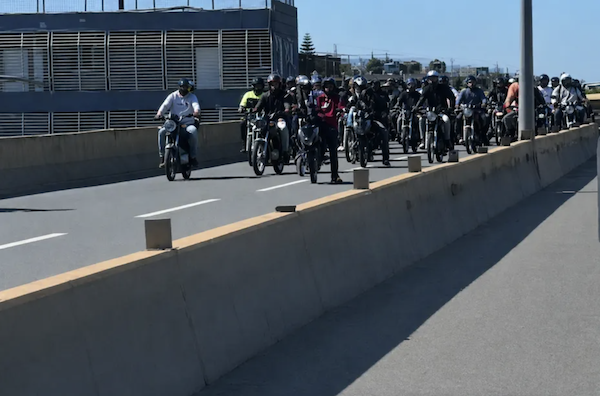
A series of viral videos documenting large groups of motorcyclists performing stunts on major thoroughfares has ignited a firestorm of criticism regarding the perceived surrender of public space to lawlessness. Remarks by Amaury Mo for En Segundos underscore a growing sentiment that the Dominican Republic has effectively “lost the battle” against reckless operators who now openly defy the General Law of Mobility, Land Transport, Transit and Road Safety (Law 63-17).
He writes that organized “swarms” of motorcyclists in recent days have been filmed taking over entire lanes on elevated viaducts (elevados). These riders are increasingly engaging in “calibrando,” the practice of popping wheelies at high speeds—while traveling in dense packs.
The use of elevated bypasses by these groups is particularly galling to the commuting public, as these routes are designed for continuous, high-speed transit. A single miscalculation during an illegal maneuver in these confined corridors risks not only the life of the rider but creates a high-probability scenario for multi-vehicle pileups and fatalities.
The enforcement gap: Law without order
While the legal framework exists to penalize reckless driving and endangerment, the consensus among urban observers and social media critics is that enforcement is functionally non-existent for this demographic. This lack of consequences has transitioned “calibrando” from a fringe nuisance into a normalized urban spectacle.
The disconnect: Digesett (Traffic Safety and Land Transportation Agency) operations are often perceived as focusing on minor infractions or static checkpoints, while mobile gangs of violators move through high-traffic zones with total impunity.
The message: The absence of immediate intervention at the moment of the infraction signals a systemic “lenience” that emboldens further lawbreaking.
A growing culture of impunity
The issue extends beyond simple traffic violations; it reflects a deeper erosion of authority. Critics argue that when the state is selective or reactive in its enforcement, the result is a vacuum filled by chaos.
As these groups “flex their muscles” in front of passive authorities, the concern is that today’s stunt on an elevated highway will escalate into more aggressive territorial control tomorrow. For a nation where road safety is a critical public health issue, the failure to rein in these “motorcyclist gangs” represents a significant retreat from the rule of law.
Read more in Spanish:
En Segundos
23 April 2026