

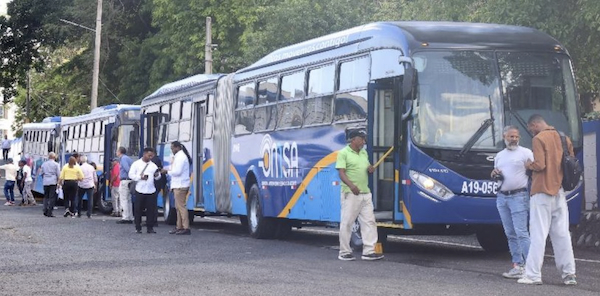
The Metropolitan Bus Services Operator (OMSA) inaugurated on Sunday, 26 April 2026 the start of a new mass transit bus system in the country. While key routes in the past were allocated to privatized transport associations, in its second term the Abinader administration is investing heavily in a modernized system that starts with the comprehensive renovation of the 27 de Febrero Avenue corridor. During the launch, it was announced that the route would be expanded to reach Los Alcarrizos in northern Santo Domingo and will extend to connect all of Greater Santo Domingo.
To encourage adoption of the modernized system, OMSA is offering a 15-day grace period during which passengers can transfer between Santo Domingo Metro routes free of charge. Afterwards, the fares will be RD$35, the same as charged by the transport associations on their routes. But the OMSA routes are integrated with commuters able to continue on Santo Domingo Metro subway and skylift units. Additionally, the administration is evaluating a fare-exemption program for the elderly and citizens with disabilities.
As one of the most vital arteries in Greater Santo Domingo, 27 de Febrero Avenue route serves as the backbone of the city’s east-west transit, connecting Santo Domingo West (SDO), the National District, and Santo Domingo East (SDE). The 27 de Febrero corridor is more than just a roadway; it is the main link between east and west Santo Domingo. Stretching from the Induveca area near the Manoguayabo highway in the west to Hípica Avenue near the Hipódromo V Centenario in the east, it facilitates the daily movement of tens of thousands of commuters, and then becomes the Las Americas Expressway all the way as it continues to the east provinces.
As reported, the new bus route encompasses operating between 35 and 75 buses during rush hours to handle peak hour volume, for up to. 6,000 people per hour. Each unit has the capacity to accommodate up to 90 passengers.
Modernization and integration
According to an official press release from OMSA, this relaunch focuses on renewed buses and a modernized user experience designed to alleviate the financial burden on Dominican families. These units integrate with other transport systems, such as the Santo Domingo Metro and Teleférico (cable car), reducing the per trip cost for long distance commuters across Greater Santo Domingo.
The system seeks to address the high cost of public transportation in the country, outside of the routes covered by the subway lines. Today, the Dominican Republic currently faces the highest transportation cost burden in the region, with nearly 17% of the basic food basket’s value consumed by transit expenses. This surpasses neighboring nations like Panama (16.35%) and Costa Rica (15.01%), and is nearly double the cost seen in Nicaragua, El Nacional reports on 25 April 2026.
According to the Regional Center for Sustainable Economic Strategies (CREES), this disparity is not driven by geography or global fuel prices, but by a rigid organizational structure where transport associations have historically controlled routes. This quasi-monopolistic control, coupled with state-mandated tariffs, has historically stifled competition and removed any incentive for operators to optimize efficiency or improve the quality of the aging fleets that dominate the capital’s streets.
In response, the government’s strategic relaunch of OMSA corridors, particularly the vital 27 de Febrero east-west artery, represents a direct challenge to this long-standing “syndicate” model. By introducing modernized, high-capacity buses and integrating them into a single-fare system with the Metro and Teleférico, the state aims to break the cycle of inefficiency that transfers high operational costs and long commute times to the end user. This transition is critical not only for household savings but also for national competitiveness, as the current “anarchy” of disorganized transit inflates the price of consumer goods and limits the productivity of the workforce across Greater Santo Domingo.
What’s coming
Supported by technical assistance from the French Development Agency (AFD) and the Inter-American Development Bank (IDB), OMSA is collaborating with the Trust for the Development of the Mass Transportation System (Fitram) to evolve into a Bus Rapid Transit (BRT) model. This plan includes the acquisition of specialized buses with doors on both sides to facilitate boarding from central platforms within counter-flow lanes.
“The plan for the exclusive BRT lane is being finalized,” Oneximo González, OMSA’s executive vice president stated during the Sunday launch of the 27 de Febrero service. “Buses must have their own monitored lanes to ensure they remain free of obstacles.”
Gonzalez explained that exclusive transit lanes will be instated in the near future across the main corridors taken on for the OMSA buses. He says this will include a “counter-flow” system in high-traffic areas. González emphasized that dedicated lanes are essential for operational efficiency and will be strictly monitored by the Traffic Safety and Land Transportation (Digesett) and the National Institute of Transit and Transportation (Intrant).
To ensure compliance, motorized agents will patrol these corridors. Unauthorized drivers who park in or utilize the bus lanes face fines of RD$5,000. González noted that crews are already installing signage to alert motorists of the new enforcement measures.
Addressing the workforce, González announced a salary increase for drivers. Monthly wages will rise from RD$30,000 to RD$40,000, while operators of high-capacity articulated units will see salaries reach RD$50,000. “When people see the quality of the service, they will return to OMSA,” González affirmed.
Gonzalez was appointed to head the OMSA in August 2025, the head of the Metropolitan Bus Services Operator (OMSA). Previously, he had created the National Student Transport System (TRAE) within the Ministry of Education to provide transport to public school students. He is remembered for his transforming transport in Greater Santo Domingo with the Onatrate bus model during the President Antonio Guzman administration (1978-1982).
An engineer by profession, Onéximo González is recognized as a technical specialist with extensive experience in urban mobility and infrastructure.
Read more:
Diario Libre
El Nacional
27 April 2026