

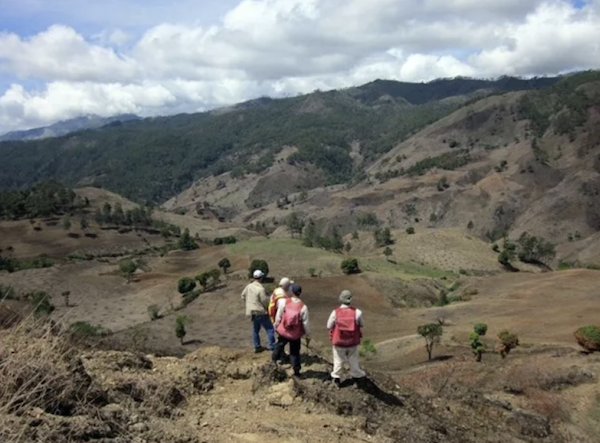
Will San Juan de la Maguana become the new Sanchez Ramirez province? Will the Abinader administration authorize exploitation that could be a first step for the gold rich province to turn into a hub for other mining projects to take advantage of the strategic assets under the mountains of the Dominican Republic?
The debate on the proposed “Romero Project,” a gold and multi-resource extraction initiative spearheaded by the Canadian-based firm GoldQuest, continues as the community voices its environmental and historical concerns. It is about the contrast between the historical stance that the area is the country’s primary water source and whether proposed modern mining can enable the proponents and the country to enjoy the short term profits of gold while the long term liabilities to the environment, population and country’s finances are reduced to a politically-acceptable minimum.
The Dominican Academy of Sciences (ACRD) in the past had opposed mining in the province. Now under the presidency of judge Manuel Ramon Herrera Carbucia, and with outspoken economist and business consultant Jose Luis de Ramon as treasurer, the ACRD is open to the arguments that the extraction will bring more good than bad to the Dominican Republic.
For years, the Dominican Academy of Sciences has opposed the extraction. In a recent report, environmental expert Jose Manuel Mateo Felix, the environmental team director for the ACRD states that the traditional opposition of the institution has been rooted in the country’s historical experience with the mining sector. He noted that previous operations in provinces such as Pedernales, La Vega, Monseñor Nouel, and Sánchez Ramírez have often resulted in “eternal environmental liabilities” with negligible improvements to the quality of life for local communities.
Mateo Felix, in addition to being the current executive director of the Environmental Team of the Academy of Sciences of the Dominican Republic, is also the national director of Biodiversity at the Ministry of Environment. And he serves as National Coordinator for the Caribbean Region of REDPARQUES (the Latin American Technical Cooperation Network on National Parks and Protected Areas).
“Mining in this country does not inspire confidence in its execution because, historically, it has developed in violation of the law,” Mateo Felix told Listín Diario. “These are not just words; these are concrete observations based on past performance.”
The “Mother of the Waters” at risk
The Academy has emphasized that the Romero Project would directly impact the Cordillera Central, often referred to as the “Mother of the Waters.” This ecosystem generates approximately 80% of the water consumed in the Dominican Republic. This water supply is vital for:
• National food security (agriculture and livestock).
• Human consumption via municipal aqueducts.
• Hydroelectric power generation.
• Industrial development and the tourism sector.
Mateo Felix argues that the short-term economic gains of gold extraction, which he described as “sporadic and unsustainable,” cannot be compared to the permanent damage to the San Juan Valley. The valley has served as the “Granary of the South” for centuries. The San Juan River not only feeds this valley but also flows into the Yaque del Sur, providing water to Barahona, Pedernales, Bahoruco and Independencia.
Legal and constitutional challenges
The Academy environmental specialist contends that mining in this region is not only a violation of Law 202-04 on Protected Areas but is also unconstitutional. Mateo Felix cites Article 15 of the Dominican Constitution, which defines water as a “strategic national patrimony” that is inalienable and essential for life.
Furthermore, Article 16 protects biodiversity and endemic species, granting the state special powers to ensure their preservation. The Cordillera Central contains 20 distinct zones that are part of the National System of Protected Areas (SINAP).
A call to action
The ACRD in the past has urged the Ministry of Environment and the Ministry of Energy and Mines to withhold both exploration and exploitation concessions in the Central and Northern (Septentrional) ranges, with past president Luis Scheker strongly opposed to the Romero Project stressing the gold exploitation in the vulnerable mountain area would impact water sources that are protected by the Constitution.
While GoldQuest has always that its underground mining methods will minimize surface impact, Mateo Felix warned that the subsoil activity could contaminate “the veins of the water,” altering geological and hydrological patterns that eventually affect surface rivers and streams.
Mateo Felix warns of the social cost, noting that such activities would force local residents to abandon their ancestral lands, homes and traditional livelihoods.
Yet the Academy, now under new leadership, is open to giving its green light to “modern mining.” The Academy is serving as independent oversight in the environmental evaluation Goldquest has contracted to AECOM. President Luis Abinader has stated that the study will be the deciding element in the granting of the exploitation permit. The President has been active in instating new leadership for development projects in San Juan de la Maguana as the Goldquest debate is ongoing.
Likewise, contrasting also with the traditional position of the Dominican Academy of Sciences, is the incorporation in the oversight committee of very vocal and convincing mining expert Osiris de Leon who brings another pro-Goldquest perspective to the lobbying for the exploitation permit.
Osiris de León has consistently expressed a supportive technical view of the GoldQuest Romero project, emphasizing its design as a model for “new mining.”
De León concurs with the proponents that the Romero project is a strictly underground operation. He says since the extraction will occur approximately 200 meters below the surface, it will not pose a threat to the surface ecosystem.
He maintains that the project will not require the removal of trees or topsoil, as the activity is confined to deep tunnels.
He has stated that the volcanic rock structure in the area lacks significant groundwater, dismissing concerns that mining would contaminate subterranean aquifers used for farming.
One of the most contentious points in San Juan is the potential impact on the Sabaneta Dam and the San Juan River. De León has publicly discarded the possibility of damage to these water bodies, arguing that the project design avoids the use of toxic chemicals like cyanide or mercury.
He points to the planned use of “dry stack” tailings and the returning of waste rock into the tunnels as backfill, which prevents acid rock drainage and protects the river’s water quality.
In early 2026, De León was part of a high-level commission from the Academy of Sciences (alongside treasurer José Luis de Ramón) that met with government ministers. During this process, he has advocated for the Strategic Environmental Evaluation (EAE) in addition to the standard Environmental Impact Study (EIA) to ensure maximum transparency and scientific rigor. The EIA study has been contracted by Goldquest to AECOM.
De Ramon went public on his X account to make the point that the Dominican Academy of Sciences has not issued its official stance on the GoldQuest Romero project. De Ramón notes that while some members “fervently support” the project and others “fervently oppose” it, these remain individual opinions.
He said that the Academy is currently preparing a comprehensive, multi-disciplinary report that covers the ecological, economic, and legal aspects of the proposed mine. The official institutional verdict will only be released once this study is complete.
In February 2026, De Ramón led a commission, including prominent figures like geologist and mining expert Osiris de León to meet with the Ministers of Energy and Mines and the Environment. At that time, the Academy was designated to act as an independent observer for the project’s Environmental Impact Study (EIA).
What Luis Carvajal has to say
Meanwhile, longtime ACRD member, Luis Carvajal, the prominent biologist, ecologist, and coordinator of the Environmental Commission of the Universidad Autónoma de Santo Domingo (UASD), is one of the most vocal opponents of the GoldQuest Romero project.
His position is characterized by a “technical rejection,” where he acknowledges certain engineering improvements but maintains that the location and the precedent it sets are unacceptable for the Dominican Republic.
Carvajal argues that the project is located in the most sensitive part of the Cordillera Central, the source of the country’s primary water supply. He contends that any mining activity there, no matter how “clean,” risks the integrity of the Sabaneta Dam and the San Juan River, which are vital for the southern region’s agriculture and human consumption.
He warns that approving GoldQuest’s request would effectively turn San Juan de la Maguana into a “mining district.” In his view, this would open the door for dozens of other concessions already mapped out in the mountains, leading to the cumulative destruction of the nation’s most important forest and water reserves.
Carvajal maintains that the project violates Article 15 of the Constitution, which prioritizes water for human consumption and agriculture over industrial use. He argues that the state’s primary duty is to protect high-altitude river basins as “strategic national patrimony.”
Carvajal has voiced the reasons for the current distrust in enforcement. A recurring theme in Carvajal’s discourse is that the Dominican state lacks the robust oversight mechanisms needed to ensure a company adheres to “responsible mining.” He often cites “eternal environmental liabilities” left by other mining projects in the country as evidence, despite these promising sustainable mining operations.
A technical nuance: subterranean mining
Carvajal has made a distinction between mining methods. In recent interviews (including April 2026), he has acknowledged that the underground mining system proposed by GoldQuest is technically the least impactful method that exists compared to open-pit mining.
Yet, he states that even the “least impactful” method is too dangerous for the Cordillera Central. He believes the company is “selling a narrative” of sustainability that ignores the long-term geological and hydrological risks of working beneath the “veins of the water.”
Millions are to be made explaining that pro-exploitation sectors align key forces in a time of record highs in gold prices. Meanwhile, grassroots communities members backed by the Roman Catholic Church organize social protests in San Juan de la Maguana and other Cibao areas to try to get heard of what is at stake if the Abinader administration endorses the short-term profiteering of mining outfits versus giving priority to water sources.
Read more:
Diario Libre
Diario Libre
Hoy
Poder Judicial
Academia de Ciencias
Listin Diario
Academia de Ciencias
Presidency
DR1 News
Instituto Geografico Nacional
28 April 2026