

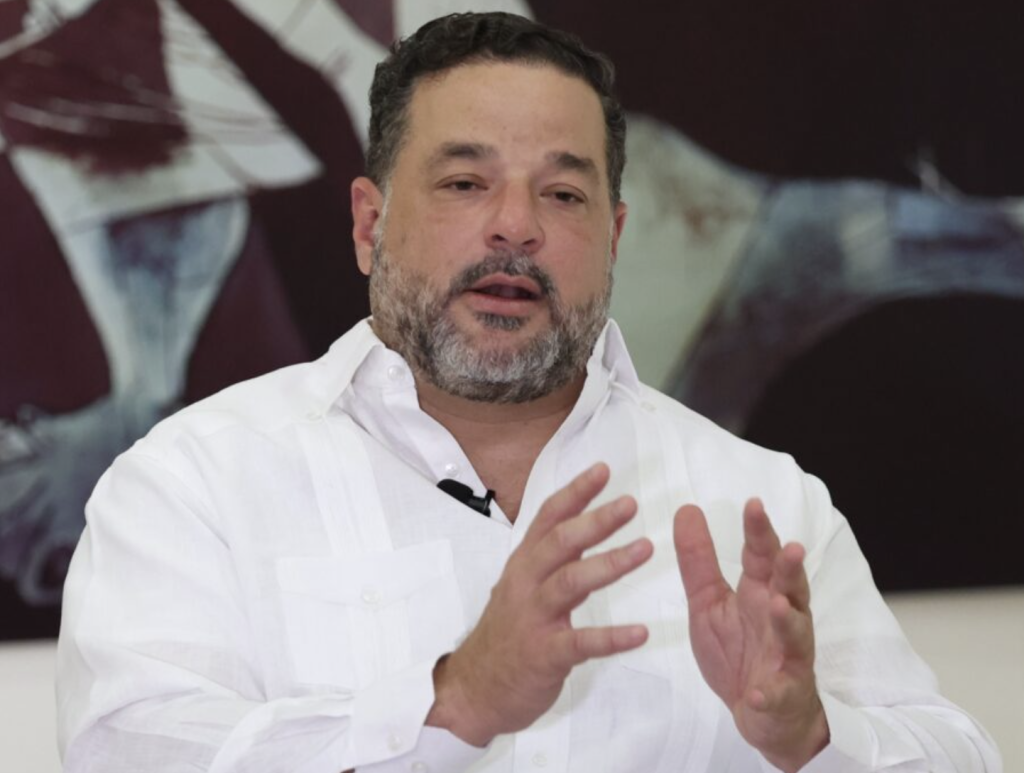
Minister of Environment Armando Paino Henríquez stated that it is time for the Dominican Republic to decide once and for all whether it wants to continue as a mining nation or pivot to a different economic model. Speaking with El Día and the “Hoy Mismo” program, Henríquez clarified that the government is currently awaiting a formal Environmental Impact Study (EIS) from GoldQuest to evaluate the Los Romeros gold project in San Juan de la Maguana. He emphasized that the project has not been approved and the final decision is pending on that evaluation’s results.
The Minister explained that his role is that of an evaluator, not an automatic granter of permits. After years of stagnation of the Romero Project, in 2024, the Ministry of Environment formally activated the technical process by defining the “Terms of Reference” that the company’s study must satisfy. Henríquez stressed that this phase is strictly technical and he said will involve rigorous filters, internal reviews, and public consultations.
Furthermore, the Minister supports the preparing of a broader “Strategic Environmental Evaluation” for the entire San Juan de la Maguana province, noting that the region already suffers from severe water stress and the degradation of the San Juan River basin and the Sabaneta Dam due to decades of poor agricultural practices.
Historically, mining in the Dominican Republic has not provided a clear “plus” for the provinces where it is concentrated. In Sanchez Ramirez and Monseñor Nouel, where mining operations are or have been most active, major environmental damages and local population diseases are considered an undisclosed part of the true cost of extraction. This track record has led communities in other provinces, such as Monte Plata, to flatly reject the installation of mining ventures.
The debate proposed by Minister Henriquez for the country to decide whether it is a mining country or not would mirror the path taken by Costa Rica, a country that decided to ban open-pit metal mining years ago. Costa Rica leaned into its “Essential Costa Rica” brand, betting that a standing forest is worth more in tourism dollars than a gold mine is in royalties. Today, tourism in Costa Rica accounts for roughly 8-10% of their GDP, reinforcing the country’s status as a top global destination for nature-conscious travelers.
Costa Rica was also a divided country between to mine or not to mine. One Canadian company, Infinito Gold sued Costa Rica after the country revoked its legal concession to operate the Las Crucitas gold mine, claiming a violation of the Canada-Costa Rica Bilateral Investment Treaty (BIT). The company argued it had not received “Fair and Equitable Treatment” (FET) after spending 20 years and millions of dollars on the project. They claimed “legitimate expectations” because the project had been declared of “national interest” by the Arias administration in 2008. However, when the Costa Rican Legislative Assembly unanimously banned open-pit mining in 2010, the company viewed the move as an unlawful expropriation of its investment. Eventually, in World Bank arbitration, Costa Rica obtained a favorable decision and did not have to pay the US$94 million penalty demanded by Infinito Gold.
Meanwhile, in the Dominican Republic, parallel to the Goldquest mining advances, those who oppose mining in the Cordillera Septentrional area are also taking actions to impede the exploitation, bringing to the forefront the point raised by Henriquez that the country has to decide if it is a mining country or not.
In a recent development, the ecology and environment commission of the Dominican Episcopate Conference (CED) announced its support to the communities that call for the conservation of the Central and Septentrional mountain ranges in the Cibao region.
In the ruling Modern Revolutionary Party-majority National Congress, legislators are divided in their support. The president of the Senate, Ricardo de los Santos has said he is pro-mining.
N Digital shares an overview and update of the sides taken by government officers and environmental and community groups in its reporting.
Read more in Spanish:
El Dia
Diario Libre
Listin Diario
Hoy
Noticias SIN
Noticias SIN
Noticias SIN
CDN Interview with Nelson Bautista
N Digital
29 April 2026