

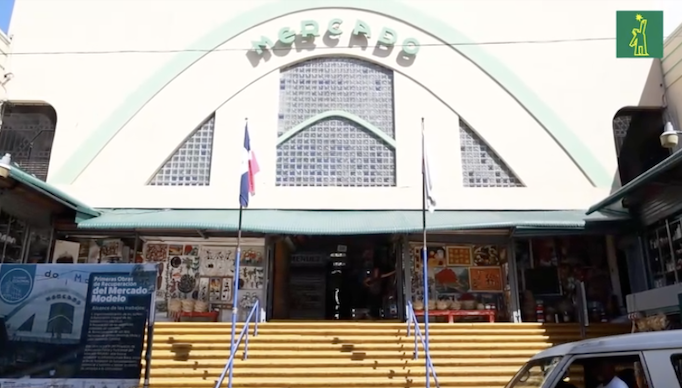
The Mercado Modelo has been improved as part of the Integral Program for Tourism and Urban Development of the Colonial City, with RD$45 million invested from Inter-American Development Bank (IDB) funding.
The Mercado Modelo is a historic landmark in Santo Domingo, functioning both as a practical supply center for locals and a premier destination for travelers. While it is technically located on the northern edge of the Ciudad Colonial (Colonial City) on Mella Avenue, it is considered an essential extension of the colonial tourist circuit.
Renovations are ongoing, yet the market has never closed to visits. The market is open from 9am and generally closes at 6pm from Monday through Saturday. On Sundays, the market is open from 7am to 12 noon.
Built during the Trujillo era and designed by Henry Gazón Bona, its Art Deco-influenced architecture provides a sharp contrast to the 16th-century Spanish colonial style of the nearby Alcázar de Colón.
The initial intervention focused on urgent stabilization, including structural reinforcement, complete waterproofing of the central vault and flat roofs, and the restoration of the building’s two primary facades.
Wilfredo Féliz, coordinator for the Mercado Modelo component of the program, told Diario Libre that the primary objective was halting severe water damage. “The roof was completely permeable, posing a significant structural risk,” Féliz told Diario Libre.
The scope of work was expanded beyond surface aesthetics. Technical assessments led to specialized anti-corrosion treatments for exposed steel within beams, columns, and slabs to ensure long-term durability.
The electrical grid of the market was replaced with a system that enables individual modules for each vendor. Anastacio Ozoria, the market’s administrator, told Diario Libre that the upgrade has already eliminated the frequent fire hazards caused by irregular “spider-web” connections.
A modern high-capacity transformer and an emergency power plant are part of the new infrastructure.
The renovations are in a second phase with the remodelling of the central pavilion and the reorganization of internal stalls.
The market is divided into two distinct atmospheres: the interior artisan stalls and the exterior fresh produce markets.
Artisan Crafts and Jewelry: Inside the 1942 building, there is a vast concentration of Dominican and Haitian art. It is a place to buy larimar and amber jewelry.
Folk Heritage and Santería: The market is known for its “botánicas” or Santería shops, which sell herbal remedies, incense, amulets, and religious statues. Reviewers often mention these shops as one of the most culturally unique aspects of the market.
Traditional goods: Vendors offer hand-carved wooden figures, colorful carnival masks, hand-woven baskets, and locally made textiles.
Fresh produce and spices: The exterior of the market spills into the surrounding streets, where you can find fresh tropical fruits, vegetables, local coffee beans, cacao, and aromatic spices like cinnamon and cloves that are imported but are part of Dominican gastronomy.
The market is situated just outside the old city walls, making it easily accessible on foot from the heart of the colonial district. From the Santo Domingo Cathedral and Columbus Park, the market is an approximately 15-minute walk.
Read more in Spanish:
Diario Libre
12 May 2026