

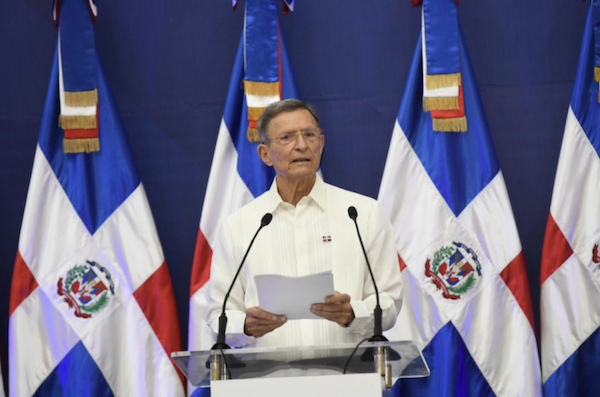
Minister of Foreign Relations Roberto Alvarez addressed the media on the afternoon of 13 May 2026 to clarify the Dominican government’s motivations behind the recently signed Third Country National Agreement with the United States.
Following a wave of public inquiry, Alvarez emphasized that the bilateral cooperation, which facilitates the reception of foreign nationals with pending US deportation orders, is a product of a strategic partnership rather than external pressure.
Sovereignty and national security
Alvarez was emphatic in stating that as a sovereign nation, the Dominican Republic frequently receives requests from international partners, but retains the ultimate authority on whether to comply based on national interests.
“The Dominican government receives requests from all its partners. It does not receive pressure,” the Foreign Minister explained. “We decide which to accept and which are not convenient based on a matter of national sovereignty and national security.”
As evidence of this independence, the Minister highlighted that Haitian nationals were explicitly excluded from the agreement. He further clarified that the memorandum is non-binding, lacks legal consequences for non-compliance, and can be terminated by either party at any time.
Alvarez pointed out that same-region countries, such as Costa Rica, Ecuador, Honduras and Paraguay, have signed similar agreements with the United States.
The foreign minister on the specific migration or transit initiative stated that it does not involve permanent residency or the integration of migrants into the local population. “We are not talking about permanent settlement, nor migratory absorption, nor judicial processes in the country. It is a controlled, temporary transit operation, carried out under parameters of national sovereignty and international cooperation,” he said.
A logical partnership
According to the Foreign Minister, the request from the United States was primarily a “logistical matter.” He noted that given the strength of the diplomatic relationship, the Dominican Republic had “no reason” to decline.
Alvarez pointed to reasons of reciprocity and previous milestones, mentioning the US allows Dominican citizens to apply for the Global Entry program. He said the Global Entry agreement is a benefit of this high-level cooperation, noting that very few countries have been granted such access. He also mentioned the human ties between the populations of both countries.
He underscored that millions of Dominicans reside in the United States, receiving a high proportion of permanent residencies relative to the national population, which fosters an “extraordinary” cultural and economic bond.
Alvarez also pointed to the decisive US leadership in addressing the Haitian crisis. He cited US support for UN Security Council Resolution 2793, which established the Gang Suppression Force (GSF) for Haiti, a move the Dominican Republic had long advocated for to protect regional security.
Alvarez says it encompasses receiving around 30 individuals every month.
Addressing concerns regarding legislative oversight, Álvarez clarified that the document was signed as a Memorandum of Understanding (MoU) rather than an international treaty. Because it is an MoU, the Ministry determined it did not require prior approval from the National Congress or the Constitutional Court.
Despite this, Álvarez expressed his full willingness to appear before Congress to explain the details of the pact, asserting that “there is nothing to hide; this is completely transparent.”
Separately, the Dominican Republic also has in place with the United States an agreement that permits the access, parking, and overflight of US aircraft and personnel at Las Americas International Airport and the San Isidro Air Base. This arrangement, which began on 1 May 2026, is currently set to expire on 31 October 2026, though it includes an option for extension. Under the terms, the US must provide advance notice before utilizing these facilities.
Read more:
Listin Diario
Noticias SIN
New York Times
14 May 2026