

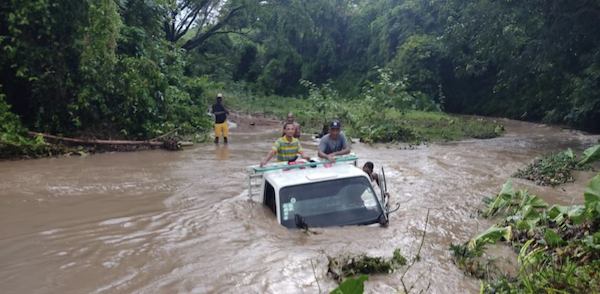
Media reports on the heavy rains that have been falling in the Dominican Republic continue to bring forth evidence that builders cannot cut corners. Cheap constructions create new vulnerabilities. Likewise, people need to know the price to be paid for moving into areas where previously there were rivers and streams.
Once again, the rains are headline news.
Greater Santo Domingo was for the most part exempt from the heavy rains over the weekend, with the exception of a downpour on Saturday evening.
As announced by Gloria Ceballos, director of the National Meteorological Institute (Indomet), the rains came on Friday and Saturday, and were intense in the central portion of the nation. The most serious damage was the washout of the San Jose de Ocoa road that halted traffic for more than a day. Rivers have flooded in La Vega and Constanza, causing personal and material damages.
In a general overview on the situation, the Center for Emergency Operations reported that some 400,000 persons are without drinking water, as 28 aqueducts are out of service due to muddy waters that clog the filters, damage to intake stations, and urban flooding.
Cities such as Dajabon, Mao, and Santiago Rodriguez saw major urban flooding with damage to housing, commercial buildings, and vehicles. In every province, local authorities and Civil Defense volunteers were urging people to stay away from rivers and streams, and advising vehicles not to attempt to cross any waterway that was at flood stage.
The dangers of the very wet soil were apparent when two persons were killed by a wall that collapsed under the weight of the water-soaked ground in Palmas de Herrera in West Santo Domingo.
And the damage continued through Saturday, as the head of the National Health Service (SNS) reported that seven hospitals had been damaged by flood waters, especially the one in Montellano, Puerto Plata province, which was promptly supplied with a mobile hospital from the COE.
For his part, President Abinader told reporters Saturday afternoon that the government would be sending major caliber assistance to Montellano, Puerto Plata, where residents suffered from significant flooding and several bridges were damaged.
Presidential Minister, Jose Ignacio Paliza gave the reporters a run-down as to the various damages suffered in Puerto Plata province. President Abinader traveled to Montellano to assess for himself the extent of the damage. So far, government assistance has consisted in home goods, like mattresses, sheets, towels and cookware, as well as food rations. In Montellano, 2,190 families received a monetary emergency funding of RD$7000 per family.
The heavy rainfall continues to cause flooding and expose the vulnerabilities of cheap constructions.
Conversely, the Center of Emergency Operations has issued urgent warnings to parents to prevent children from crossing rivers and streams during current weather alerts.
Read more in Spanish:
CDN
Diario Libre
Listín Diario
Diario Libre
Diario Libre
Diario Libre
Listin Diario
Listin Diario
Listin Diario
El Caribe
El Caribe
20 April 2026