

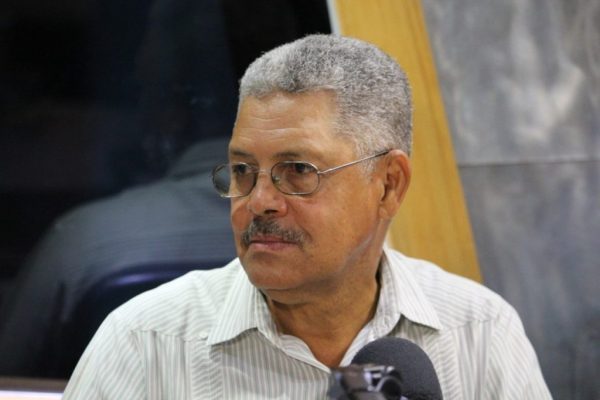
Following the passage of a significant trough on 7 April 2026 and 08 April 2026 that paralyzed the National District and San Cristóbal, prominent ecologist Luis Carvajal is calling for a radical shift in urban planning, asserting that the resulting “natural disasters” are actually the physical consequences of human negligence. Carvajal, the Coordinator of the Environmental Commission at the Autonomous University of Santo Domingo (UASD) and a member of the Academy of Sciences, argues that the city’s vulnerability stems from a model of development that prioritizes land speculation over “territorial intelligence.”
Carvajal notes that the systematic filling of wetlands, which naturally store excess water, and the sealing of the city with impermeable concrete have transformed streets into high-speed funnels for runoff. The expert explains that the climate crisis is exacerbating these events, but the local collapse is fueled by the destruction of living systems and a failure to respect the ancient hydrological paths that the water “remembers” even after they are paved over.
Read the opinion piece by Luis Carvajal:
“It must be said again: The water is not to blame
Since yesterday, Tuesday, 7 April, and continuing through today, Wednesday, 8 April 2026, the trough has once again written its harsh calligraphy across Santo Domingo, San Cristóbal, and much of the country.
This was no isolated shock. It was another warning from the heavens to a territory that insists on behaving as if water were an exceptional visitor rather than the ancient owner of the landscape.
That is why it is worth repeating, more firmly than ever, what I have written before: the water is not to blame. Rain does not commit crimes.
Rain does not conspire. Rain does not lobby. It does not fill in wetlands at dawn, it does not clog ravines with trash, it does not sign reckless permits, and it does not mistake “development” for rebar and concrete.
Water falls, seeks a slope, obeys gravity, and remembers—with a memory older than our city governments—where the land used to breathe before a slab of cement was pressed over its mouth.
What we usually call a “natural disaster” is, all too often, nature moving through a human disaster.
The city forgets and the water remembers. That is the tragedy. It is not that the rain invades; it is that we occupy its path. It is not that the downpour turns evil; it is that we design neighborhoods, avenues, and urban developments as if runoff were a rumor rather than a law of physics. It is not that the water arrives with inexplicable fury; it is that we have built asphalt highways, enclosing walls, and high-speed funnels for it.
For years, science has been telling us in a sober voice what we still prefer to hear as exaggeration.
We will experience more water-related shocks, both from excess and absence. More floods. More droughts. More days when the country feels like the sky is falling, and more months when the earth cracks like stale bread.
We are not facing a tantrum of the weather. We are facing the physical response of a planet subjected to too much violence.
The climate is not the culprit, but it is being wounded. It is wounded by a model of development that burns, razes, and accelerates. It is wounded by fossil fuel dependency.
It is wounded by deforestation. It is wounded by the devastation of living systems that help regulate water and carbon. It is also wounded by wars, with their massive energy consumption and their machinery of smoke, fire, and ruin. And it is wounded, too, by the destruction of marine plankton and the forests that still work, in silence, to cool the world, tame the water, and sustain its deep breath.
But even within this global crisis, there are very domestic, very personal, and very visible faults. Impermeable surfaces reduce infiltration and increase runoff. Wetlands, conversely, store water during floods and help preserve it during droughts.
The equation is simple and takes no excuses: every filled wetland multiplies the risk; every section of the city sealed without hydrological criteria accelerates the damage; every ravine treated as a nuisance returns later as a warning. Rain does not collapse a city on its own: a city collapses because it forgot how to absorb the rain, how to slow it down, how to let it pass, and how to let it be.
Therefore, the discussion should not be against the water, but in favor of territorial intelligence. Every meter of occupied land should answer a question that precedes any business deal or ribbon-cutting:
What will the water do here when it arrives? Where will it enter? Where will it exit? Where will it rest without killing or destroying? Which part of the ground can absorb it? Which area must remain free so the water can perform its ancient work without tragedy?
Planning a country without putting water at the center is like designing a house and ignoring the existence of fire.
Sooner or later, reality collects its debt.
We need, once and for all, land-use planning whose main axis is not land speculation, but the dignity of water.
Do not occupy floodplains. Do not fill in wetlands. Do not seal the city until it becomes a tray. Do not turn avenues and streets into highways for destructive torrents. Do not continue calling “modernity” everything that accelerates runoff and expels infiltration.
True progress does not consist of forcing water to disappear from the map, but in giving it routes, pauses, pores, memory, and respect.
Because in the end, the phrase remains intact, clearer under the downpour than under the sun: the water is not to blame.
The blame lies with a civilization that still thinks it is smarter than the slope, with a policy that listens more to business than to the watershed, and with an urbanism that wants to domesticate the rain without first having learned to read it.
Water is not the enemy. Water is the exam. And every time we fail that test, the city wakes up to a report card in red ink, sending us back to do our homework and correct our notes.
Luis Carvajal.
Who is Luis Carvajal?
Luis Carvajal Núñez holds a prominent position at the Universidad Autónoma de Santo Domingo (UASD) as the Coordinator of the Environmental Commission (Comisión Ambiental).
In addition to his leadership role in the Environmental Commission, his status at the university and in the Dominican scientific community includes the following details:
Academic Role: He is a professor and researcher, specifically linked to the School of Agronomic Engineering (Escuela de Ingeniería Agronómica).
Scientific Standing: He is a distinguished member of the Academy of Sciences of the Dominican Republic, where he has served on the Board of Directors (Consejo Directivo).
Background: He is a biologist by training with a Master’s degree in Biological Sciences (specializing in Plant Physiology and Biochemistry) from Maxim Gorky University in Russia.