

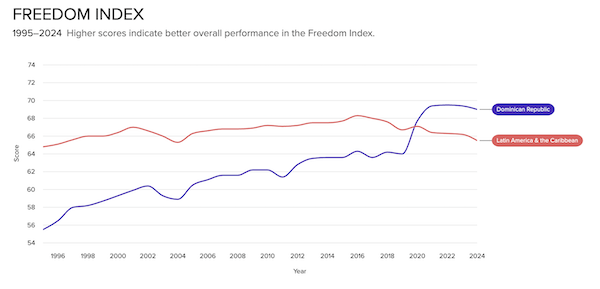
A newly released report by the Atlantic Council, published on 30 March 2026, systematically diagnoses the Dominican Republic’s most pressing national debates through a 30-year macroeconomic lens as judicial independence, fiscal reform, informal labor and nearshoring. Authored by Marino Auffant for the Freedom and Prosperity Center’s 2026 Atlas, the document evaluates the nation’s political, economic, and legal evolution, outlining structural successes while targeting the deferred reforms holding the country back.
Marino Auffant is a Dominican-born international historian and geopolitical strategist who serves as a Nonresident Senior Fellow at the Atlantic Council’s Scowcroft Center for Strategy and Security. He holds a PhD in International History from Harvard University and leads the boutique advisory firm Auffant Global. Domestically, he has served as an advisor to the National Association of Free Zones (Adozona) alongside the Ministry of Industry, Commerce, and MSMEs (MICM) to develop the country’s National Semiconductor Strategy. His academic research on energy markets recently earned him the Munich Security Conference’s John McCain Dissertation Award.
The report moves beyond daily political cycles to explain why systemic bottlenecks persist despite decades of leading regional economic growth. It notes that the transition from an agrarian society to a diversified economy is largely complete, but moving from a middle-income equilibrium to high-income status requires confronting what the author terms a “political culture of indefinite deferral.”
Key details from the report highlight the country’s political and institutional consolidation. The Dominican Republic has avoided the democratic backsliding and constitutional ruptures common across Latin America since the decisive elections of 1996. Even during the 16-year governance of the Dominican Liberation Party (2004–2020), competitive elections were maintained. The suspension of the February 2020 municipal elections severely tested the system, but constitutional boundaries held, and power ultimately transferred peacefully.
Following the 2020 transition, the appointment of an independent attorney general significantly improved the country’s legal subindex. High-profile corruption investigations successfully expanded beyond past administrations to include current governing coalition members. However, the report cautions that judicial inertia and procedural constraints mean final convictions have been slower to materialize, demonstrating that prosecutorial autonomy alone does not equal systemic judicial transformation.
A major hurdle identified is fiscal reform. The report highlights informal structural constraints on the executive branch; because the President’s party generally controls the legislature, real checks on executive power come from civil society, trade unions, and business associations. A primary example is the executive’s withdrawal of a major fiscal reform proposal in 2021 due to strong societal opposition. Broadening the tax base and strengthening state capacity remain critical, unresolved challenges limiting long-term investment.
Furthermore, while the economic growth model has reduced aggregate inequality, persistent informality creates ongoing structural dualities, notably regarding Haitian migration. The massive use of undocumented Haitian labor in construction, agriculture, and services operates alongside mass deportations, creating an environment of “intractable ambiguity.” Relying on ad hoc arrangements for employment, education, and healthcare risks long-term social stratification, deeply tests the state’s institutional capacity to manage integration and prevents new forms of societal segmentation.
Looking ahead, the Dominican Republic is exceptionally well-positioned externally, particularly regarding US trade, nearshoring and supply-chain strategy. To fully leverage this advantage and escape the middle-income trap, the economist understands government must execute deferred structural reforms targeting educational quality, institutional effectiveness and fiscal capacity. The next era of development requires leaders to make politically costly decisions to spur human capital formation and productivity, rather than merely making choices designed to preserve baseline stability.
Read more:
Atlantic Council
29 April 2026