

The bad reputation mining has in the Dominican Republic led the population to reject Loma Miranda, the expansion of the Falconbridge project in Monseñor Nouel. Today, Falconbridge foreign operators are gone, and the Dominican government has been left with the high cost of remediating the damages to the environment.
Another unfortunate situation has occurred in Sanchez Ramirez province. Gold mining remediation has not kept up with the pace of environmental damage caused by gold mining operations. These are leaving a heavy burden for future generations to deal with contamination and remediation.
Now, Goldquest, a Canadian company that cannot own up to any mine exploitation, is intent on getting the permits for the gold in the hills of San Juan de la Maguana, promising a modern underground mining operation.
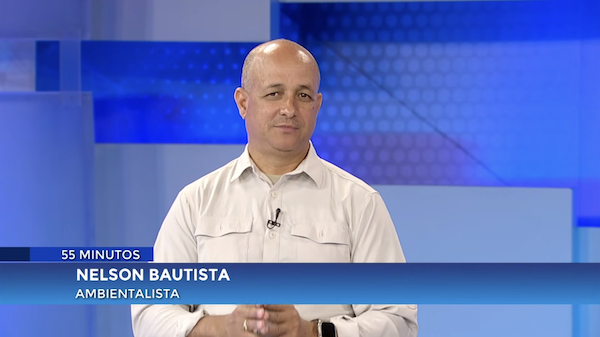
Nelson Bautista, who has made a name for himself as spokesperson for the Sociedad Ecológica del Cibao (Soeci), the Santiago-based environmental group, is optimistic social pressure will once more spare the province from what Sanchez Ramirez has suffered. He says, as has occurred in the past, all the money involved could buy the so-called social license, rigging this procedure and presenting the results to the Ministry of Environment.
Yet, in the case of the Goldquest in San Juan de la Maguana, he says this will not be so easy because of all the influential people oppose the gold mine and have done so for the past two decades. During the Danilo Medina administration, the government listened and the Goldquest did not move forward.
“Mining has earned its reputation,” Nelson Bautista told Julissa Cespedes of CDN. He says this is a consequence of the impact mining has already had on water sources in the Dominican Republic that has created a trauma and that is why communities do not want mining. He called the recent closure of Falcondo in Monsenor Nouel “a calculated and perverse blow.” “We are left with another environmental liability. Hatillo Dam is being contaminated.”
“Pesticides and fertilizers [are factors], but one that is having the most impact is the open-pit mining left behind by Falcondo,” observed the expert in sustainability.
“With those two precedents (Falcondo and Barrick Pueblo Viejo), no community that values itself wants a mining company nearby,” he explained.
“Nelson Bautista is opposed to mining exploitation upstream.” He explained the Academy of Sciences proposed instead that the government involve itself in a strategic environmental study, vital to determine the viability of any other project within the context of a valley as fragile as the San Juan Valley.” He said the proposal is very wise and it will serve to determine what is best for San Juan de la Maguana.
“Bautista explained the strategic environmental study will determine the viability of any other project within the context of a valley as fragile as the San Juan Valley.” He said this is not a study for the mining company to pay for. “The country should do that,” he said.
He said generalized opposition could stop the venture as happened years ago in the case of Loma Miranda exploitation proposed by Falconbridge Dominicana, the same mining venture that left the country, leaving behind a massive environmental liability.
“Why do the authorities force them to accept this intervention if the community has already said they do not want it?,” asked Cespedes during the interview. Bautista explained that the amount of gold is significant, motivating the corporation to persevere in the endeavor.
Nelson Bautista explained that as has happened in the past, the company could buy its way to obtain the social license. To get the license, a public hearing with community members from a different area can be maneuvered. “They get a list, take it, and the Ministry of Mines grants it to them. A trick,” he explained.
He says the social license is unlikely to be issued fairly for the Goldqauest area. In his opinion, generalized opposition is a stronger thermometer to measure what the community says about the project.
Bautista warns: “The challenge for the country—in a global context of war where people take refuge in gold [and this has gold prices at record highs] —is: what if the value drops as it did with nickel and Falcondo? What happens with a mining operation that carves open the mountain, then claims it is no longer is profitable and leaves?”
“It is one of the great dilemmas in a state of intense water fragility. In San Juan, it is fragile, and if you contaminate it, it kills the entire region. It produces a third of the country’s food.”
He recalls a recent video by filmmaker Jose Maria Cabral offering: “’I’ll trade you trinkets for gold.’ This is the game, he says. “Mining companies offer everything.”
Bautista backs the proposal of the Academy of Sciences for a strategic study. “The country must do this [undertake the drafting of a strategic study]. The mining company cannot exploit the land because, regardless of other factors, it lacks a true social license; it is evident that San Juan society does not agree.”
Bautista says the strategic report will point to the ecotourism resources to be developed in the areas near Palomino Dam. Non-traditional crops such as grapes can be planted in the San Juan Valley, in addition to traditional beans and onions. Tourism and these crops are not compatible with mining, he stresses.
He says there is much farming potential still in the San Juan basin, especially for non-traditional crops. “We have focused on beans and onions,” he says, but now is the time to plant grapes. He remarked that mining exploitation would scare off new farming ventures.
He is hopeful the population of San Juan de la Maguana will exercise their influence.
“Now it will be more difficult because half the country is watching. San Juan has resources on its side: informed judgment.”
He advocates “to make it difficult for the interested parties to buy the will of those who allow themselves to be bought”. He says people need to put on a balance what they will gain and what was promised to the people in Cotuí or Bonao — “Bread for today, and hunger for tomorrow.”
Who is Nelson Bautista?
Nelson Bautista and the Sociedad Ecológica del Cibao (Soeci) are central figures in the environmental conservation movement in the Dominican Republic, particularly in the northern Cibao region.
Bautista is a prominent Dominican environmentalist and researcher. He currently serves as secretary of the board of the Santiago Botanical Garden (Profesor Eugenio de Jesus Marcano Fondeur).
In this role, he has been instrumental in managing the garden as a “democratic space” for social integration and scientific research, recently overseeing the construction of its new Visitor Center and seed bank.
At Soeci, he has a long history with the organization, having served as its president from 2005 to 2007. He remains an active voice for the group, often acting as a consultant or representative on critical environmental issues.
Environmental Advocacy: He is a founding member of the Coalition for the Defense of Protected Areas (Coalición para la Defensa de las Áreas Protegidas). He is frequently cited in national media for his critiques of territorial planning, mining pressure in the Cordillera Septentrional, and the health of the Yaque del Norte River.
Sociedad Ecológica del Cibao (Soeci)
Founded on 29 December 1976, Soeci is the oldest environmental organization in the Dominican Republic. Based in Santiago, its primary goal is the conservation of natural resources and the promotion of ecological awareness. The organization is renowned for its management of the Pico Diego de Ocampo Natural Monument, the highest point in the Cordillera Septentrional.
Recent Activity: As of April 2026, Soeci continues to lead reforestation efforts, having planted over 250,000 trees, and provides environmental education programs for students, such as the 60-hour social service requirement.
Follow the story in Spanish:
CDN
30 April 2026