

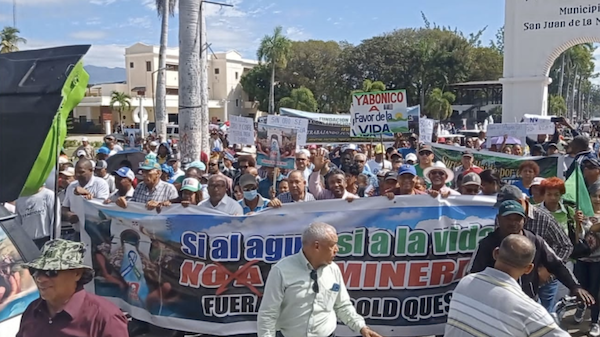
The long-standing conflict over the Romero gold mining project in the San Juan Valley reached a boiling point on 27 April 2026 as local communities initiated a 24-hour general strike, paralyzing commerce, transport, and education. Protesters, united under the slogan “Agua sí, oro no” (Water yes, gold no), are demanding the definitive rejection of the project proposed by the Canadian multinational GoldQuest.
The same project had been rejected during past administrations for the same reasons.
The tension underscores a deep-seated lack of trust in the mining industry’s promises of economic prosperity. Critics argue that the history of extractive industries in the Dominican Republic is marked by legal irregularities and environmental degradation, leaving local communities with little more than depleted resources.
A legacy of mistrust
Jose Manuel Mateo Feliz, is a prominent environmentalist and agriculture engineer with a long career in the Dominican Republic’s environmental sector. A member of the Natural Sciences and Environment Commission of the Academy of Sciences of the Dominican Republic, he emphasizes that the mining sector lacks credibility among the populace. He notes that, historically, mineral extraction in the country has often bypassed existing laws, failing to deliver the promised sustainable development.
Mateo is one of the country’s experts in natural resources, having directed the protected areas department at the Ministry of Environment during various administrations, overseeing the planning and management of the National System of Protected Areas (SINAP).
Now from his position as head of the environmental sector at the Academy of Sciences he has formally rejected any extractive activities in the area, citing the “incalculable environmental wealth” of the Cordillera Central, which serves as a vital ecological balance for the entire nation and the primary water source for the agricultural heartland of the San Juan province.
According to GoldQuest, the deposits located in the Romero area are significant. Data from the company’s official site estimates the deposits at 840,000 ounces of gold, 980,000 ounces of silver and 135 million pounds of copper.
GoldQuest has defended the technical merits of the project, stating that it would use an underground mining method designed to avoid surface impact. However, residents, who have been organized against the project since 2012, remain unconvinced, fearing the irreversible contamination of the region’s watersheds. For the local population, the priority remains the preservation of agricultural production, which has been the economic backbone of the region for generations.
Government calls for dialogue
In response to the escalating protests, the Minister of Energy and Mines Joel Santos advocates for a balanced approach between environmental protection and economic growth. He stated that any final decision must be “based on scientific evidence” and respect due process through transparent dialogue with the affected communities. Santos’ sister-in-law was the president of Barrick Pueblo Viejo for many years.
Despite the government’s call for mediation, social and community organizations in San Juan de la Maguana reiterated that their commitment to defending natural resources is non-negotiable.
Meanwhile, the executive director of the local Chamber of Mining and Petroleum (Camipe), Martin Valerio insists in an interview with El Dia that mining and protection of the environment can co-exist.
Read more:
El Nacional
N Digital
CDN
El Dia
30 April 2026