

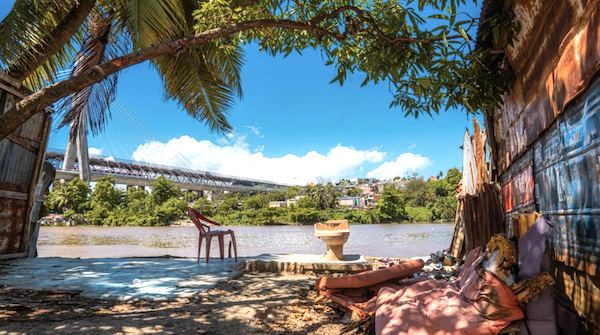
The Dominican government is intensifying efforts to transform the banks of the Ozama River into a sustainable urban corridor, an initiative expected to impact the lives of 62,815 people. Minister of the Presidency José Ignacio Paliza recently toured the project site in the Las Lilas sector of Los Tres Brazos, Santo Domingo Este, highlighting a total investment of RD$409.5 million.
The first phase of the project now under the Abinader administration, authorized by Decree 521-25, focuses on recovering public spaces and converting them into safe, green areas equipped with sports facilities and modern infrastructure. To date, over 200 families have been relocated from the river’s edge, with the government aiming to clear approximately one kilometer of the riverbank by July 2026.
Urban development and environmental impact
The restoration seeks to address long-standing environmental degradation in what Minister Paliza described as “the heart of the capital.” Key technical aspects of the first stage include:
• Infrastructure: Construction of a 325-meter linear primary road featuring two lanes, tree-lined sidewalks, and modern lighting.
• Green space: The creation of 6,000 square meters of parkland and the planting of approximately 200 trees.
• Environmental remediation: Sanitation efforts intended to reduce environmental pressure on Greater Santo Domingo and decontaminate the river.
Minister Paliza emphasized that the initiative follows a participatory urban model similar to the Nuevo Domingo Savio project carried out during the Danilo Medina administration, which integrated housing titling programs, security outposts, and recreational spaces for the elderly.
Social management and community concerns
The Unit for the Readjustment of Neighborhoods and Environments (URBE) is coordinating the relocation of 365 families living in high-risk conditions. URBE Coordinator Rocío Vidal noted that while 200 families have already moved, 98 additional structures are currently in the evaluation process.
The relocation process includes:
• Compensation: Financial indemnification based on official appraisals and structural evaluations.
• Logistics: Assistance with moving costs and social accompaniment.
• Targeted Support: For residents with mobility or health issues, URBE is managing nearby housing options and facilitating government pensions.
Despite these measures, the project faces some community pushback. Several residents expressed concerns that compensation offers that have been ranging from RD$300,000 to RD$450,000 are insufficient to secure comparable housing elsewhere, even in cases where the offers exceed the market value of the current informal structures.
Future phases
A second stage of the project is scheduled for bidding in July 2026. This phase will continue the recovery of the eastern bank of the Ozama, focusing on expanding the “green corridor” and improving mobility via new parking areas and bus stops.
The project is a collaborative effort involving the Ministry of the Presidency, the Ministry of the Environment, and the Mayor’s Office of Santo Domingo Este (ASDE).
Read more in Spanish:
Presidency
6 May 2026