

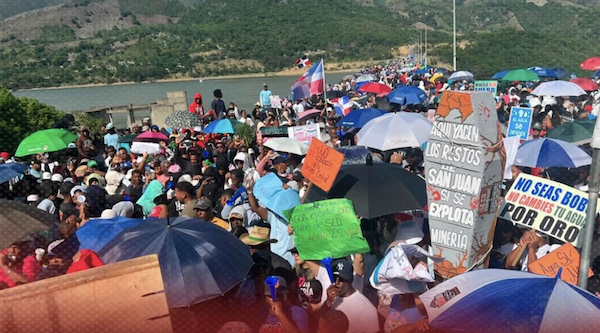
A new major protest is organized for Sunday, 24 May 2026 as residents in Cordillera Septentrional areas where the government has granted mining concessions for exploration, seek to be heard. The Ministry of Energy and Mines has been issuing exploration concessions in the mountainous area. Similar protests recently led President Luis Abinader to call for a halt to Goldquest efforts to secure its exploitation permit for a San Juan de la Maguana gold deposit.
The continued protests are led by Catholic priests and community members grouped as Unidos Somos Mas. They come especially from the 14 provinces of the Cibao that reject new mining ventures. The group says that the area is a farming one that will be impacted by mining.
As a continuation of the protests against the exploration and subsequent mining exploitation of the Cordillera Septentrional, the priests and community members of the Unidos Somos Más grouping are calling on the population to join the next march in rejection of mining. The march is set for Sunday, 24 May 2026 as of 2pm, departing from the Monument to the Heroes of the Restoration. The route includes Las Carreras Avenue, Antonio Guzmán Avenue, Del Sol Street, Cuba Street, and again Las Carreras Avenue to finish at the starting point.
The National Commission for Ecological and Environmental Pastoral Care of the Dominican Episcopal Conference (CED) expressed its support for the communities and people of goodwill who, exercising their rights, peacefully promote the preservation of the Central and Septentrional mountain ranges, as reported in Noticias SIN. The commission has joined the demand that these territories be protected from mining activities, considering that they could compromise the ecological integrity of these areas and affect their role in the country’s hydrological cycle. The priests urge the authorities to listen to the outcry of the communities that are demanding respect for both mountain ranges.
Recently, major protests of the population of San Juan de la Maguana led the government to call a halt to the procedures for the Goldquest sought exploitation permit.
Meanwhile, Minister of Environment Armando Paino Henriquez has said the government needs to decide if the country is open to mining or not.
The Chamber of Mining (Camipe) and the National Business Council have criticized the Abinader administration for halting the phases of the environmental study it had recently authorized to Goldquest. The defenders of the gold mine development insist the rigorous technical analysis of the study would guarantee sustainability standards.
Martin Valerio, of the Mining and Petroleum Chamber of the Dominican Republic (Camipe), warns that stopping the environmental impact study for the Romero project being carried out by the company GoldQuest does not protect the environment, but rather leaves the situation without the rigorous analysis it requires.
The Mining and Petroleum Chamber of the Dominican Republic (Camipe) have gone public to express concerns about the institutional implications of the measure, pointing out that the standstill of an Environmental Impact Assessment Study (EEIA) affects the predictability of the regulatory system. Martin Valerio of Camipe maintains that the environmental impact study is the tool that would allow for the necessary inputs to sustain an informed conversation, a process that he explains is also shared with communities as it progresses. Camipe considers that the measure must be viewed transversally, understanding that it affects legal principles enshrined in the Constitution, such as legal security and due process.
The Chamber understands that Goldquest should continue its work of socializing the project and calls for using the corresponding mechanisms to maintain a dialogue with the government to explain the importance of concluding the environmental impact study, not only for the benefit of the company, but for the community and the country. Camipe emphasizes that the completion of the study would allow for decisions to be made with better information regarding the possible impacts of the operation.
Environmentalists say more action is needed
On the other hand, environmental specialist Luis Carvajal told Noticias SIN that while the presidential decision to halt the Goldquest steps towards the exploitation permit represents progress, the underlying problem is not resolved. Carvajal explained that the Goldquest Romero Project is only part of a broader system of mining concessions in the region, which requires a structural review of the model: “Romero is only a small front within a broader concession and multiple concessions in the area.”
The environmentalist maintained that social pressure was decisive in the government’s decision and highlighted the organization of local communities as a key factor. Nonetheless, he warned that the debate must go beyond a single project and address issues such as land use, water management, and the environmental fragility of the San Juan de la Maguana valley. He also insisted on the need to update the mining legal framework and to strengthen environmental evaluation processes with a vision of State policy: “It is a mandatory requirement of the Dominican State to define a correct legal framework and consult the population.”
Those who oppose mining refer to the current negative experiences of the Falconbridge and Barrick Pueblo Viejo operations on the population, the environment and farming in Monsenor Nouel and Sanchez Ramirez provinces.
El Dia reports that GoldQuest shares plunged following the Dominican government’s decision. The company is currently analyzing the legal implications of the government’s sudden halt on the San Juan de la Maguana gold mine project.
Read more:
Noticias SIN
Noticias SIN
Listin Diario
Listin Diario
El Dia
El Dia
N Digital
El Nacional
El Caribe
Diario Libre
Reuters
Mining
DR1 News
DR1 News
6 May 2026