

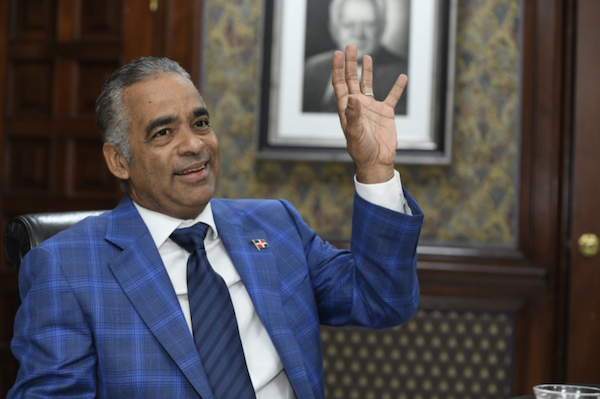
Energy and Mines Minister Joel Santos visited Listin Diario to lobby for the mining sector in the Dominican Republic. Santos called for a positive perception of mining, insisting that sustainable extraction can coexist with environmental protection while providing a critical economic buffer.
Speaking during the recent Listín Diario press breakfast, Santos addressed the recent government decision to halt the Romero gold project in San Juan de la Maguana, framed within the context of a pending legislative overhaul of the country’s 55-year-old mining laws.
The Romero Project and public consensus
Minister Santos defended President Luis Abinader’s definitive halt of the Romero project, describing it as a necessary response to “clear public outcry” and social opposition in the San Juan province. However, the Minister noted that from a strictly technical standpoint, the decision ideally required the completion of environmental impact studies to definitively determine the project’s viability.
“My wish is for San Juan to make the best decisions for its development,” Santos stated, noting that while the halt respects social sentiment, the ministry’s role is to ensure future projects are backed by rigorous technical and environmental data.
Mining as an economic counter-cyclical engine
While agriculture remains the economic backbone of the province of San Juan de la Maguana, Santos argued that national resilience depends on diversification. He highlighted mining’s unique role as a “counter-cyclical” sector, one that maintains or increases tax contributions and production even when international markets or other local sectors face recession.
To illustrate the sector’s fiscal weight, Santos provided the following data:
• 2024 revenue: RD$18 billion.
• 2025 revenue: RD$45 billion (contributing significantly to growth despite a global geopolitical slowdown).
• Q1 2026 Growth: The energy and mining sector grew by 7.7% in the first three months of this year.
• Foreign Direct Investment (FDI): Energy and mining accounted for 40% of all FDI in the first quarter of 2026.
Legislative reform: Updating the 1971 framework
A central pillar of the Minister’s agenda is the reform of the Mining Law, which has not been updated since 1971. Santos argued the current law is obsolete and fails to address modern technological and environmental standards.
The proposed reform, which Santos expects to submit to the Legal Executive Branch within 60 days, focuses on:
Streamlining approval procedures: Modernizing the bureaucracy of mining concessions.
Technology integration: Updating legal requirements to reflect modern extraction methods.
Environmental oversight: Strengthening monitoring and impact mitigation protocols.
Community Benefits: Ensuring a larger share of mining revenue remains in the local communities where extraction occurs.
Santos reassured international observers that the Romero decision is project-specific and does not signal a shift in the Dominican Republic’s pro-investment stance. He emphasized that the state remains committed to protecting the rights of both local and foreign investors, provided they adhere to the forthcoming standards of “responsible mining.”
Read more:
Listin Diario
7 May 2026