

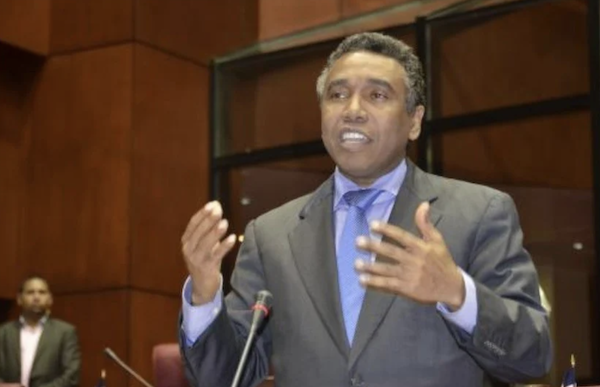
Senator Félix Bautista (Fuerza del Pueblo – San Juan de la Maguana) has voiced a definitive rejection of proposed mining exploitation in the Cordillera Central, warning that mining is an existential threat to the region’s water supply and the integrity of the Sabaneta Dam. He is an advocate of turning San Juan de Maguana into a mecca for water storage ventures.
The senator’s remarks come amid heightened tensions in the province, following a 12-hour general strike that paralyzed the area as residents protested potential gold extraction. Bautista cautioned that mining operations would necessitate diverting the San Juan River, a move he claims would lead to water contamination and jeopardize the primary tributary feeding the Sabaneta Dam.
Environmental and legal risks
During a press conference, Bautista emphasized the strategic importance of the Cordillera Central, the country’s central mountain range, noting it serves as the nation’s “water tower,” supplying both the north and south. He argued that the project would endanger the livelihoods and health of more than 700,000 people in the San Juan Valley and surrounding regions.
Beyond environmental concerns, the legislator asserted that the mining initiative would violate several legal frameworks, including:
• The Constitution of the Dominican Republic
• The General Law on Environment and Natural Resources (64-00)
• The Law on Territorial Planning and Land Use
• A standing ruling by the Constitutional Court
Alternative energy proposal
There is concern if the Goldquest mining project is approved, San Juan will become a mining district when more concessions seek exploitation permits. Bautista proposed instead rebranding the province as an “Energy District.” He advocated for the implementation of two pumped-storage hydroelectricity (PSH) projects designed by the Dominican Hydroelectric Generation Enterprise (EgeHID).
According to the senator, these storage projects would offer superior economic and environmental benefits compared to gold extraction.
Regional solidarity
The senator confirmed that San Juan remains in a state of “permanent struggle” against the Goldquest proposed mine. He says he is backing the region’s high-ranking ecclesiastical authorities who also oppose the Romero Project. “San Juan will remain on its feet,” Bautista stated, reinforcing that the social and environmental costs of the project far outweigh any projected financial gain for the region.
Senator Félix Bautista has frequently cited Ruling TC/0158/19 from the Constitutional Court as a key legal instrument to defend San Juan’s water resources against the “Romero” gold mining project. While the Constitution does not contain a specific clause naming San Juan, the Constitutional Court ruling establishes a critical precedent regarding environmental protection and the right to water as superior to mining interests in ecologically sensitive areas. Article 15 of the Dominican Constitution declares that “Water constitutes a strategic national heritage for public use, is unalienable, imprescriptible, and essential for life.”
Bautista and regional environmental groups argue that because the “Romero” project sits at the headwaters of the San Juan River and affects the Sabaneta Dam, any exploitation would violate the constitutionally protected right to a healthy environment and clean water.
Additional legal barriers cited
Beyond this specific ruling, the senator’s legal challenge rests on:
Law 64-00 (Environment and Natural Resources) prohibits activities that compromise the integrity of essential watersheds.
Article 61 of the Constitution guarantees the right to health, arguing that cyanide-based extraction (common in gold mining) poses an unacceptable risk to the 700,000 residents dependent on that water.
Bautista backs instead turning the San Juan de la Maguana province into a clean energy district.
A first Caribbean Pumped-Storage Hydroelectricity Project is set for San Juan de la Maguana. The project is part of the EGEHID Master Plan 2028 developed with the British consulting firm Mott MacDonald.
The Pontificia Universidad Católica Madre y Maestra (PUCMM) Water Management Unit and the Dominican Hydroelectric Generation Enterprise (EgeHID) recently held a conference titled “Pumped-Storage: A New Alternative for Water Storage” to outline the impacts the transformative energy strategy will have for the Dominican Republic.
Pumped-storage hydroelectricity (PSH) functions as a massive natural battery designed to stabilize the national power grid. The system operates via two reservoirs at different elevations:
• Energy storage: During periods of low demand or excess renewable production (solar/wind), surplus electricity is used to pump water from the lower reservoir to the upper one.
• Energy generation: During peak demand hours, the water is released back down through turbines to generate electricity instantly.
• Grid stability: This “revolution in storage” addresses the intermittency of solar and wind power, ensuring a robust and consistent supply.
Project timeline and strategic impact
EgeHID general manager Ángel Rafael Salazar confirmed that construction at the Sabaneta site is scheduled to begin by mid-2026. The project is being integrated into a broader energy master plan in coordination with the Ministry of Energy and Mines.
By implementing this technology, the Dominican Republic positions itself as a regional pioneer in energy innovation.
The project has already drawn significant attention from global firms interested in the country’s transition toward a diversified and sustainable energy matrix.
Read more:
El Nacional
El Nacional
CDN
PUCMM
EgeHID
30 April 2026